Sunday, October 05, 2008

Le Cadeoau Du Cheval (The Horse Gift)


Someone sent me a link to this mural a while ago, and I just assumed that most horse people had seen it as well. But, I've been told that I am very wrong, and I should put this link out there. This remarkable mural is made up of 238 individual paintings and panels done by 174 artists from all over the world. It was unveiled September 3, 2008 at Spruce Meadows in Calgary, Alberta, Canada. It will be traveling to different venues (such as the National Finals Rodeo in Vegas and the Quarter Horse Congress) for the next two years. After that, it will be donated to a permanent public showcase. Check it out!

The image at left shows the creative team of Phil Alain, Paul Lavoie and Lewis Lavoie (photo credit Lavoie Studios).

Thursday, June 12, 2008

Osprey Packs and Leave No Trace Team Up for a Youth Writing Contest

I've always been a huge advocate of the Leave No Trace Principles, and firmly believe that if we teach our kids to respect the backcountry and its wildlife, we have a shot at preserving the natural beauty around us for future generations to enjoy. In that spirit, I'd like to spread the word about the writing contest that is being sponsored by Osprey Packs. If you have or know any youth that can put pen to paper and has ever hiked or ridden, let them know about this opportunity.

KIDS: You must be between the ages of 6 and 16 to enter. In 250-500 words, tell about a place you have hiked or backpacked that was especially memorable for you. Why is it special (good or bad)? Did you encounter any animals? Was the area taken care of well or poorly? Last but NOT least, choose one of the seven Leave No Trace principles and tell us how you applied it to your adventure. You are also welcome (but not required) to include a photo of yourself - especially if it was taken on the adventure you chose to write about.

When asked how long this contest will last, Osprey answered, "Until we get every kid out there hiking and Leaving No Trace!" Maybe so, but you should probably get your entries in as soon as you can. All winners will receive a Sprint Series pack, be featured on Osprey's website , and possibly have your entry printed in an Osprey catalog. Also, winners will be featured in an upcoming Leave No Trace newsletter.

Send your entry to sprintcontest@ospreypacks.com with the subject "Reading and Writing". You'll be notified within 30 days if you are a winner. For more information, go to the Osprey Packs website.

Friday, May 30, 2008

Gaited horses arrive in Montana

Gaited horses sure have become popular here in Montana these last few years but it has been some 70 years since they first arrived. How do I know that? Well, my grandmother's brother had a son by the name of Kenny Gleason. I'm not sure what relation that makes me to him - cousin once or twice or thrice removed, maybe? Kenny and his wife Alice started a dude ranch in the late 1920's, and in 1938 decided they needed to introduce some bloodlines to their string that not only would appeal to their eastern clientele, but could negotiate the rough trails of the Rocky Mountains.

Alice Gleason recorded the stories of those years, and they were found in a closet after her death in 1997. The best of them have been published in a book titled Starting from Scratch: The Adventures of a Lady Dude Rancher. Alice wrote an article entitled "Developing the Trail Horse" for American Horseman in November, 1940. It is included in the book, and details the development of their mountain horse string using Montana's first Tennessee Walker. An excerpt from this article is shown below.

From the Northern Rockies, where our ranch is located, to Middle Tennessee is a far cry. Too far even for smoke signals from Blackfeet Country but still not to far for us to haul a Tennessee Walking horse stallion in a horse trailer, 2,400 miles from Lewisburg to the ranch! And all to carry out an experiment, amid the guffaws of our neighbours, of cross-breeding fine, good natured, smooth Westbrook's Colonel Allen 370197 with the lowly "cayuse" of the Indian country. Why do we want to do this? To try to get the ideal trail horse for our dude ranch business. We must have gentle, sure-footed, quick-witted, tough horses and yet they must be spirited, easy gaited and have style and finish or the dudes won't like 'em. The work is on rocky mountain trails from 5,000 to 9,000 feet and each day's workout ranges between ten and thirty miles. The cayuse can take it; but he doesn't have the beauty, height or style favored by easterners.

We were somewhat concerned about bringinga southern-bred horse into this cold northern climate, especially in the fall of the year. Old-timers shook their
heads and said, "He'll never make it. The first blizzard'll get him." However, it was now or never for us, and we needn't have had any qualms. "Colonel" was dumbfounded at the first snowfall. He pawed it , snorted and whistled at it, bit it and raced around full of excitement over it and then got down to business and grew a fine winter coat, just like any range horse would do. We did not try to keep him blanketed and prevent him growing a heavy coat because we were still uneasy about the bitter winter ahead. We kept him stabled, of course, but there were few days all winter that he wasn't out at least for his exercise and, to the old timers' amazement, he "made it."
Written by the late Alice Gleason
Reprinted in "Starting from Scratch",
Compiled and edited by Genny Barhaugh &
Carol Guthrie of Choteau Montana.
Published by Star Route Publishing.
I was lucky enough to see The Colonel when I was about 10 years old. He lived to a ripe old age and sired hundreds of colts and fillies that joined one of the best dude strings in Montana. I often stop in to see the Gleason ranch, originally called the Circle 8 Ranch. A magnificent piece of Montana history, it is now called Pine Butte Guest Ranch and is owned and operated by The Nature Conservancy.

Friday, August 10, 2007

Grizzly Bear Central

It's been awhile since my last post, and I sure wish I could say it was because I was out in the woods! But, we're keeping busy at Outfitters Supply. Not only is it our busiest time of year, but we are finalizing a couple of new products that I'm very excited about. I'll let you know more as we draw closer to final production, but I will say the the trailMax saddlebag line will be a little more well-rounded and our Decker pack saddles just may see another huge improvement!

Of course, I can't work ALL the time, so I did get out into the backcountry for a quick in and out trip with my wife, Maxine, and two close friends, Vic and Puck Workman. We entered the astoundingly beautiful Glacier Park National Park and started our ride at Lake McDonald. Our destination: Trout Lake and Arrow Lake, otherwise known as "Grizzly Bear Central". You may have read or been told about "Night of the Grizzlies". Well, Trout Lake is where the famous grizzly attack took place. However, we only saw scat on the trail as the bears must have been elsewhere avoiding the heat.

In just 4 miles, we went up and over a mountain and back down the other side. On the way up we gained about 2,500 feet in elevation, and then we lost about 2,000 of it going back down into Trout Lake. Arrow Lake was only another three miles, so we kept pushing, hoping to get there before the heat of the day. But, by the time we reached the lake, it was already 95 degrees, so all horses and humans dove right in for a dip.

We did get in some fabulous dry-fly fishing as well. The far end of Arrow lake produced several 13 - 15" cutthroats. We debated going another 3 miles to Camas Lake, but decided it was just too much to ask of the horses in that kind of heat. All in all, we had a great time, and since we walked quite a bit to give the horses a break, we could even say we had a good workout ourselves.

The following pictures are (in order): Puck Workman, Vic Workman, and Russ and Maxine Arnold. All were taken at Arrow Lake in Glacier National Park.


Thursday, July 19, 2007

Bernice ready to complete final stage of ride

Bernice will be leaving the cool comfort of the Astoria, Oregon and Naselle, Washington area on Sunday, July 22nd. Please wish her luck as she braves the head and heads up the Columbia River to Cathlamet, Washinton. From there, she is heading north to Castle Rock, east to Yakima, then just north of Spokane. She will cross over into Libby, Montana through National Forest lands to bring her back home to Trego, Montana on the back road (Fortine Creek Road).

She's excited to head home, and says it now seems like nothing to look at 700 or 800 miles of road before her. However, she is a little worried about the latest heat wave, and plans to take her time until the cooler weather of the mountains and autumn. She will be riding only from about 4 am to 10 am, then 5 or 6 pm until dark. During the heat of the day, you'll find her next to a good watering hole with plenty of shade for all three of them.

What's next? Yes, Bernice is already planning her next trip, which will take her through the desert in the winter. She will probably head back out in January or February, heading through Death Valley, the Grand Canyon and Sedona. She's excited for the new experience - she'll be taking a pack animal.

Tuesday, July 17, 2007

Placement of hobbles

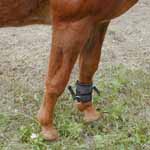
I had a customer ask me the other day where I preferred to attach my hobbles; high or low. To some extent, this is a matter of personal preference. I like to put my hobbles just above the fetlock (ankle joint), rather than down on the pastern. I haven't seen a lot of chafing when I put them here, not to mention the fact that I don't have to bend over quite as far to put them on! There are some hobbles, especially figure eight and rope hobbles that don't cinch up tightly enough to stay above the joint; just make sure that if you are using these, that they do not chafe or interfere with the flexing at the joint.

On a side note, I also like to have the hobbles up above the fetlock because I can attach both ends of the hobble to one leg while the horse is highlined or tied in camp. Then, should I want to turn the animal out to graze or stop it from pawing, I know exactly where the hobbles are and can hobble quickly. Of course, you should never leave the hobbles attached like this if you are moving down the trail or if you leave the horse unattended.

You can also read my article on training horses and mules to hobble. Just keep in mind that this article assumes that you have a gentle, willing animal to work with. Hobbling a horse or mule before it is mentally ready could be disastrous for both you and the animal.

Thursday, July 12, 2007

Chinese horses???

Just a quick entertaining blog entry today... Many have asked about the horses used by the British Long Rider Daniel Robinson. When his lawyer was asked about their origin, he said that he believed they were some sort of "Chinese" horses. Once Daniel was freed and available for comment, he confirmed the horse's origin. His trusted friends and companions for the long arduous journey were in fact... Mules!

Friday, July 06, 2007

All for the sake of a horse (snow)shoe...

The Long Rider's Guild, a wonderful organization that has dedicated itself to the preservation of the history of the horse, has just founded The Long Riders Guild Academic Foundation. This foundation is the first of its kind, and will be attempting to assemble and publish every major work known to man dealing with equestrian wisdom and history. This will hopefully create an open, useful forum for scholars, students and equine enthusiasts all over the world to combine resources and further their knowledge of the horse.

One of the first articles published was originally printed in the British Horse, written by Tom Moates. In his study of Captain Scott and his famous Antarctic tragedy, Moates concluded that Scott and Oates made one fatal error that probably caused their death. Oates did not approve of the use of horse snowshoes, and Scott listened to him, although he disagreed with Oates.

They took one set of horse snow shoes when they set out, and found that they travel twice as quickly with the snowshoes on. By this time, however, the ice had receded and they they were unable to return to camp to outfit the remaining horses. On their return, the 5 explorers perished only 11 miles away from the safety of their camp.

The Long Rider's Guild Press has just published "The South Pole Ponies", a wonderful book detailing the use Manchurian and Siberian ponies by Shackleton, Scott, Oates, etc. in two Antarctic expeditions. It's an eye-opening, interesting read, but not for the faint hearted. Best of all, "The South Pole Ponies" is available for purchase on our website. You can read the complete British Horse article on the Long Rider's Guild Academic Foundation website.

Thursday, June 14, 2007

Montana Mule Days

If it can be done on a mule, it seems like it was happening at the Montana Mule Days in Drummond. My wife, Maxine, and I made it down to watch last weekend, and definitely got our gas money back in entertainment value (even if it rained most of the time). If you have a mule days event within a couple of days drive, I highly recommend you take the time to go. Here is a partial list of some of the country's Mule Days Celebrations; let me know if you know of any more that I should add.

Competitive classes ranged from formal halter and Western/English equitation classes to driving classes to reining, roping and cattle events. There were events for the kids to compete in, such as breakaway roping, barrel crawl through, the balloon bust and "Lead your donkey/mule to water". Of course, it was Mule Days, so there were a lot of fun events you won't find at a traditional horse show or o-mak-see. Traditional classes are the log pull and the 4-up hitches. My favorites (because I wasn't competing in them) were the Flapjack race and the Packer's Scramble.

The Flapjack Race is really what it sounds like. The show supplies wood and matches. The contestants supply everything necessary to make a flapjack - the batter may be made ahead of time. No paper, charcoal lighter, starter fluid or flammable materials are allowed. All contestants line up beside their animals and at a whistle, lead a pack animal to the opposite fence. At the fence, they each unpack the animal, build a fire and cook an edible flapjack at least 4" in diameter, all the while keeping your UNTIED animal within 15 feet of the fire. The unfortunate judges have to determine if the pancake is edible.

The Packer's Scramble is also a timed event, with a pretty hefty cash pot and trophy buckles. Each team consists of 2 packers and 4 head of stock, of which at least two must be mules and must be packed. The contestants must supply the following: axe, bucket, shovel, 4 or 5 manty tarps, ropes, and normal saddle gear. The teams enter the arena, unpack their loads, turn all animals loose, and crawl into their "sleeping bags" (manties). At the signal, the contestants have to get up, catch and saddle their riding horses and pack the mules with all of the gear - plus a live chicken. They run an obstacle course with one packer leading the 2 mules pigtailed together. The other rider must be mounted as an outrider. The fastest time wins - if you arrive with all of your packs intact. I did manage to take a few pictures of this event - enjoy!


Sunday, June 10, 2007

Leave No Trace Practices

I've had quite a few questions over the years about what to do with waste while in the backcountry. There are a lot of different answers out there, but here are the recommendations that have been set by the "Leave No Trace" Center for Outdoor Ethics. Most of these principles are easy to follow and use common sense. Following these simple practices will allow us and many more future generations to enjoy a beautiful, pristine backcountry.

  • Pack it in, pack it out. Inspect your campsite and rest areas for trash or spilled foods. Pack out all trash, leftover food, and litter.
  • Deposit solid human waste in "cat holes" dug 6 to 8 inches deep at least 200 feet from water, camp, and trails. Cover and disguise the "cat holes"when finished. (see below for more detailed information)
  • Pack out toilet paper and hygiene products.
  • To wash yourself or your dishes, carry water 200 feet away from streams or lakes and use small amounts of biodegradable soap. Scatter strained dishwater.
Here is more detailed information about dealing with human waste. (I know, no one really wants to talk about it... But, we all have to deal with it, and it should be dealt with properly). Proper disposal of human waste is important to avoid pollution of water sources, avoid the negative implications of someone else finding it, minimize the possibility of spreading disease, and maximize the rate of decomposition.

In most locations, burying human feces in the correct manner is the most effective method to meet these criteria. Solid human waste must be packed out from some places, such as narrow river canyons. Land management agencies can advise you of specific rules for the area you plan to visit.

Contrary to popular opinion, research indicates that burial of feces actually slows decomposition (at least in the Rocky Mountains). Pathogens have been discovered to survive for a year or more when buried. However, in light of the other problems associated with feces, it is still generally best to bury it. The slow decomposition rate causes the need to choose the correct location, far from water, campsites, and other frequently used places.

Cat holes: Cat holes are the most widely accepted method of waste disposal. Locate catholes at least 200 feet (about 70 adult steps) from water, trails and camp. Select an inconspicuous site where other people will be unlikely to walk or camp. With a small garden trowel, dig a hole 6-8 inches deep and 4-6 inches in diameter. The cat hole should be covered and disguised with natural materials when finished. If camping in the area for more than one night, or if camping with a large group, cat hole sites should be widely dispersed.

Perhaps the most widely accepted method of backcountry human waste disposal is the cathole. The advantages are:

  1. they are easy to dig in most areas.
  2. they are easy to disguise after use.
  3. they are private.
  4. they disperse the waste rather than concentrate it (which enhances decomposition).
  5. it is usually easy to select an out of the way location where you can be certain no one is going to casually encounter the cathole.

Selecting a Cat hole Site:

  1. Select a cathole site far from water sources, 200 feet (approximately 70 adult paces) is the recommended range.
  2. Select an inconspicuous site untraveled by people. Examples of cathole sites include thick undergrowth, near downed timber, or on gentle hillsides.
  3. If camping with a group or if camping in the same place for more than one night, disperse the catholes over a wide area; don t go to the same place twice.
  4. Try to find a site with deep organic soil. This organic ma al contains organisms which will help de pose the feces. (Organic soil is usually dark and rich in color.) Refer to the jars used to demonstrate decomposition. The desert does not have as much organic soil as a forested area. (See number 2 under Digging a Cathole below.)
  5. If possible, locate your cathole where it will receive maximum sunlight. The heat from the sun will aid decomposition.
  6. Choose an elevated site where water would not normally during runoff or rain storms. The idea here is to keep the feces out of water. Over time, the decomposing feces will percolate into the soil before reaching water sources.

Digging a Cathole:

  1. A small garden trowel is the perfect tool for digging a cathole.
  2. Dig the hole 6-8 inches deep (about the length of the trowel blade) and 4-6 inches in diameter. In a hot desert, human waste does not biodegrade easily because there is little organic soil to help break it down. In the desert, the cathole should be only 4-6 inches deep. This will allow the heat and sun to hasten the decay process.
  3. When finished, the cathole should be filled with the original dirt and disguised with native materials.

Catholes in Arid Lands: A cathole is the most widely accepted means of waste disposal in arid lands. Locate catholes at least 200 feet (about 70 adult steps) from water, trails, and camp. Avoid areas where water visibly flows, such as sandy washes, even if they are dry at the moment. Select a site that will maximize exposure to the sun in order to aid decomposition. Because the sun s heat will penetrate desert soils several inches, it can eventually kill pathogens if the feces are buried properly. South-facing slopes and ridge tops will have more exposure to sun and heat than other areas.

Latrines: Though catholes are recommended for most situations, there are times when latrines may be more applicable, such as when camping with young children or if staying in one camp for longer than a few nights. Use similar criteria for selecting a latrine location as those used to locate a cathole. Since this higher concentration of feces will decompose very slowly, location is especially important. A good way to speed decomposition and diminish odors is to toss in a handful of soil after each use. Ask your land manager about latrine-building techniques.

Toilet Paper: Use toilet paper sparingly and use only plain, white, non-perfumed brands. Toilet paper must be disposed of properly! It should either be thoroughly buried in a cathole or placed in plastic bags and packed out. Natural toilet paper has been used by many campers for years. When done correctly, this method is as sanitary as regular toilet paper, but without the impact problems. Popular types of natural toilet paper include stones, vegetation and snow. Obviously, some experimentation is necessary to make this practice work for you, but it is worth a try! Burning toilet paper in a cathole is not generally recommended.

Toilet Paper in Arid Lands: Placing toilet paper in plastic bags and packing it out as trash is the best way to Leave No Trace in a desert environment. Toilet paper should not be burned. This practice can result in wild fires.

Tampons: Proper disposal of tampons requires that they be placed in plastic bags and packed out. Do not bury them because they don t decompose readily and animals may dig them up. It will take a very hot, intense fire to burn them completely.

Urine: Urine has little direct effect on vegetation or soil. In some instances urine may draw wildlife which are attracted to the salts. They can defoliate plants and dig up soil. Urinating on rocks, pine needles, and gravel is less likely to attract wildlife. Diluting urine with water from a water bottle can help minimize negative effects.

Special Considerations for River Canyons: River canyons often present unique Leave No Trace problems. The most common practice is to urinate directly in the river and pack out feces in sealed boxes for later disposal. Check with your land manager for details about specific areas.